
Seeing Gen Z mobilise has been such a relief, a massive wave of breathable (fresh) air, a shot of joy. But the way these young people are spoken about by the conservative adults representing power in France is appalling.
I write this on the 18th October 2026. Yesterday, a huge turnout had been predicted. Everyone I know, my friends whom I used to go to protests with for years, went out with a more or less conscious denial of what had happened at the last major demonstrations back in 2023, (about pension reform and Nahel Merzouk’s death) which had been violently repressed by armed police. Again, it was a huge relief to make eye contact with others, strangers and thousands of people whom I didn’t know. But we understood that we were braving the temptation of staying at home locked down in fear. We went out because we were and still are fed up and believed that, first and foremost, we had to exercise our right to protest. This very right to protest has been violated and torn up in the last ten years. We just had to do it.
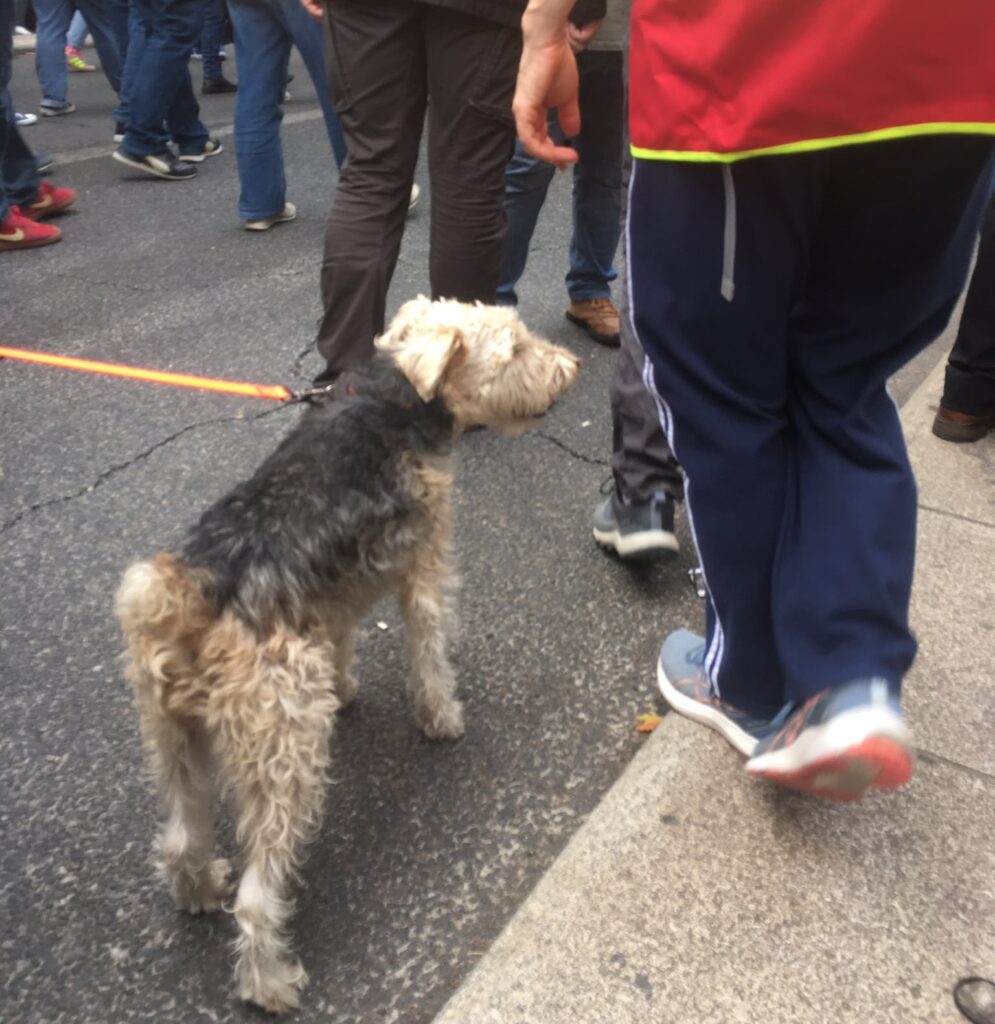
The stigma attached to young people from the Paris suburbs who are not white is palpable, and is borne out, first and foremost, by the disproportionate impact of police violence, huge amount of identity checks and random body searches on young French men first perceived as Black and Arab groups that are particularly represented in working-class neighbourhoods and the banlieues. This matters because these youngsters we are talking about are just sixteen years old. Most of them come from schools in the suburbs and working class neighbourhoods. They are the ones affected first and foremost by inequality, who began organising to demand better conditions, essentially the basic conditions they need to study and to build a future.
The Guardian reading problem
This morning, I got a text message from a friend living in Oxford:
“Hope it was positive where you were?”
I answered : “Yes it was.”
Followed by:
“It looks bad from here, as though the peaceful protests got spoiled?”
My answer:
“No, you don’t understand! We aren’t afraid of radical social change. We’ve already waited too long.”
I now feel a little ashamed of my rude reply. It was probably the tiredness, compounded by the barrage of spectacular right-wing recuperation of noisy chatter over the events of 17 October. That same old same old conservative narrative.
The fact that Tim was tapping into this narrative was not that obvious, it was rather about the subtext. He sent me a screenshot of a Guardian piece showing Limoges town hall in flames. Spectacular…
Of course, it was spectacular and kind of shocking. I fell into it straight away myself, feeling emotional about it: Shit, what a shame. This wasn’t the point of the protests at all. What happened? The burning town hall had become the focus and it covered up the rest. It’s the power of the image, a tiny moment in time can take over the media coverage and erase an enormous movement of working-class solidarity. The fact that this was that image a friend in the UK sent me that Sunday morning, after a month of no reaction from UK friends, whilst here picket lines and protests had kick-started a popular mass movement on a scale we hadn’t seen for a while, simply infuriated me.
But there is nothing spectacular about demanding decent conditions in which to study.
“All we’re getting here is stuff about everything being wrecked.”
My answer:
“Please, you do not understand the significance of what’s happened.”
Straight after that last message, as if to anticipate, I reached out to my group of South London female friends. I felt obliged to warn them, perhaps looking for emotional support and cross border solidarity, “Please don’t trust the mainstream media news.” Sonia, dearest Sonia, who is housebound, probably going back and forth between TV and social media on her latest iPhone, in her tiny co-op flat in South-London replied straight away: “I stand solidly with the protesters!” I could see her bright eyes and her mischievous genuine smile of a born ‘révoltée’.
I then finished my text message to them: “Please don’t believe what the TV or mainstream media will say! It’s an amazing Gen Z movement facing extreme police violence. The material damage we’re seeing is a tiny part of the long-term destruction caused by state brutality, which is destroying public services and people’s lives … I know you know all this, but the fact that the media now belongs almost entirely to the far right has terrible consequences on people’s opinions… I know you know – but who else knows ? xxx ”
Most of them are mothers nowadays.They’d probably missed the latest political news, being busy taking care of their toddlers.
Anna : “Yeeees, C.! I’m in awe of the next generation ! And you!”
Michele : “Be careful, my love, and thank you for protesting.”
My eyes watered up. Then, another message of a friend came through :
“ Tell me you’re okay. ”
“ I’m okay. ”
“ Good to hear that. Hope yesterday’s events haven’t played into your enemies’ hands. ”
And that was when I started wondering what the reporting in the UK was actually like.
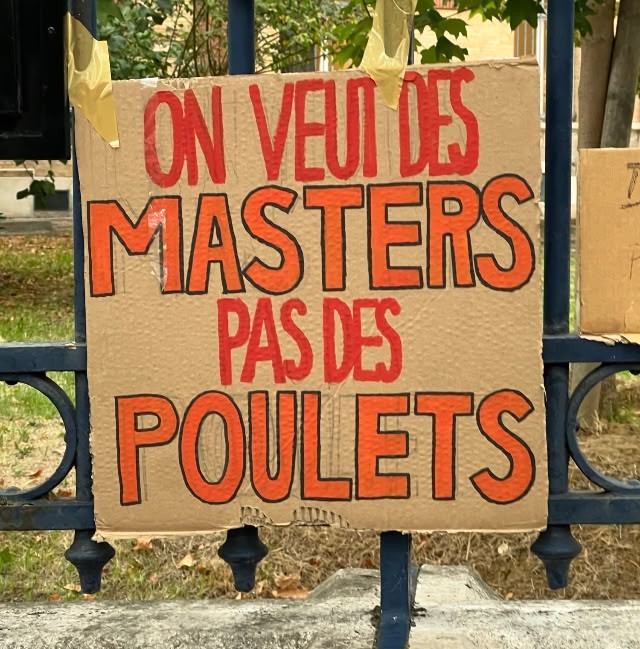
Rage against the education machine
What happened here yesterday was the direct consequence of more than ten years of Macron’s arrogance. He has listened to nobody but the neoliberal right, in spite of the many revolts against his policies since 2017.
People in the streets showed up in huge numbers on October 17th, in a massive repudiation of Macron’s policies – 800,000 according to the CGT union confederation’s figures; 500,000 according to the police). It also showed how (young) people have nothing to lose anymore. More importantly, it proved how his government and his police were willing to engineer a scene of harsh brutality.
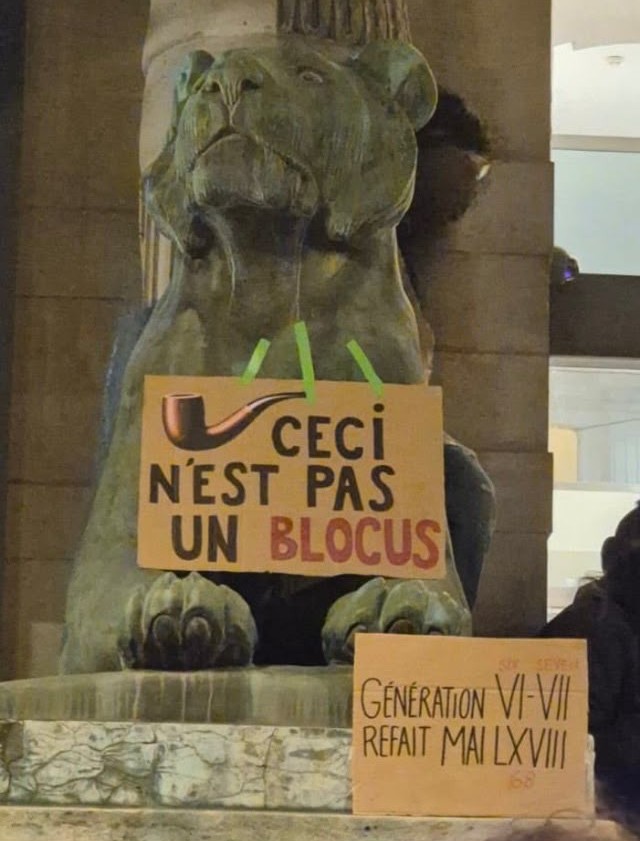
At the beginning of September, this movement of young people also rose up: sixth-formers got together with the support of their teachers and sometimes even headteachers, in picket lines outside their schools from 7 am every morning. What we call blocages, or school blockades, are the form given to a refusal to go back to work as in study and take exams and carry on as usual.
It started with a few chairs and tables blocking the front doors, but it’s mainly the critical mass of people gathering that stops people from getting in and out, that also stops the status quo continuing.
After ten years of Macron, the breakdown of the public education system has gone as far as this: many schools can spend entire terms without teachers. Teaching in public schools is an unattractive job, there aren’t enough teachers. The recruitment exam isn’t necessarily suited to the many difficulties teachers face in the lycée system. Classes are overcrowded, making it difficult for one teacher to build a relationship with every pupil. Temporary teachers are parachuted into schools without induction or proper pedagogical training; some face commutes of an hour or an hour and a half. There are two tiers of staff: permanent teachers and temporary teachers which sometimes can break the workers’ struggles in very different demands and antagonism between colleagues. Posts are left vacant to save money, while administrative teams are also understaffed. It can be almost impossible to get anyone on the phone. School buildings are run-down, too: this spring, classrooms became unbearably hot, and young people were fainting during lessons.
The current demands of the Teacher’s union Sud go like more educational psychologists, proper school health services; resources for priority education and inclusion; time for school teams; high-quality training; and salaries that reflect the work. “We want a state education system that genuinely challenges every form of segregation and fights inequality instead of reproducing it.” Pupils from the banlieues and the province, the peripheries in one word, demand decent studying conditions. They have seen ceilings collapsing before their eyes, experienced entire winters without central heating, screamed at rats and cockroaches roaming the corridors. School buildings have proved increasingly ill-equipped to withstand more and more severe heatwaves over the years. Another major demand has been to urge the government to drop their new university application system, Parcoursup. “A collective experience of anxiety, shared by all the young people and their families”, in the words of Bruno Andreotti in the 25th October edition of Lundi Matin.
Back in 2018, the introduction of Parcoursup, during Emmanuel Macron’s first year in office, met with considerable opposition from teachers, university staff, students, secondary-school pupils and parents. The opposition was not simply about a new online admissions platform. It was a political struggle against the introduction of selection into public higher education.
Since the introduction of Parcoursup, French teenagers have been required, from the age of fifteen, to make strategic decisions that may determine their future academic and professional lives. This is despite not having equal access to the information needed to make them.
Applicants with the strongest academic records are then allocated places on the most prestigious courses, whose qualifications carry the greatest currency in the labour market. The majority, meanwhile, are left in an interminable state of uncertainty. Access to higher education ceases, in effect, to be a right and becomes a reward reserved for those with the strongest applications.
The French republican ideal of education, grounded in the ambition to equip everyone with the means to read the world and free themselves from the constraints it imposes, is profoundly shaken. Parcoursup introduces a logic of competition at the very heart of secondary education. Pupils are expected to maximise their grades, choose their subjects according to the courses they hope to enter, assemble strategically constructed applications and anticipate the criteria applied by admissions committees. School thus becomes, in part, a site of competition rather than a place of learning and collective intellectual development.
Now, what was it about their picket lines in September that drew the enthusiasm of hundreds of thousand of French people, workers, pensioners that joined the movement? Kids organising ‘aura battles’, headteachers joining in and dancing with them. They were playful, cheeky, full of life and innocence.
Ma jobette
Many of my friends are sixth form teachers in the suburbs of Paris. I myself applied to the Paris and Créteil education authorities back in 2021. I had to submit an online job application that consisted of sending a CV and a cover letter. It felt like a process of endless automated systems, never really being certain the click button was effective at sending anything to anywhere, waiting for automated replies. A month and a half later, I received a phone call. An anonymous voice from an administration somewhere told me there was a job vacancy in a Lycée not far from where I lived at the time. So I had 24 hours to get ready to become the very English teacher I, alongside my schoolmates, had helped bully twenty years earlier.
Quite by coincidence, it is said that the first blockade started in lycée Antoine de Saint-Exupéry just next to the lycée where I used to work, in one of the poorest suburbs of Paris. If you happen to lend an ear to France across the Atlantic, it seems that students at Lycée du Nord in Mayotte began blockading their school as early as August 31, while students at Lycée Félix-Éboué in Cayenne were already calling for improvements to their study conditions on September 7. An article in Le Monde (21/10/26) reflects on a persistent colonial mindset in which events sparking in the centre are valued over those on the periphery, reminding us how in 1968, Guadeloupe’s 1967 uprising, led by labour movements got overlooked in the general national discourse.
Back to my job application, an email arrived from the central administration confirming that I could start two days later. It was indeed very short notice, and I did doubt my legitimacy to enter the school from one day to another asking them to call me Ms L….
So I have experienced what it’s like to enter the temp job system and how pupils learn in terribly poor conditions. First of all, the school buildings in Paris do look and feel like prisons. Foucault was right. I remember it from my teenage years, being a pupil in one of them. First, departing from the enormous shopping centre Créteil Soleil, you walk from the suburban rail station or one of the last station of the metro line, through lifeless residential blocks. The streets leading to the school are deserted. There isn’t a single shop. You arrive at a gate, a lodge to your left – some guard standing or seating in there checking you work or learn in the institution. You have to show your members pass, and open your bag. Under the blazing sun or the pouring rain you cross the concrete courtyard, riddled with potholes. The courtyard is enormous,the size of a football pitch, flat, not a tree of a plant, some unwanted weeds here and there,. There are two buildings at the back. If you arrive at certain times there isn’t anyone alive it seems.
I used to get teaching hours in the middle of the day. You have to follow the signs if there are signs. The first day, I remember looking for the classroom where I knew a group of thirty students was going to be waiting for me and I didn’t dare ask pupils in the corridor because I didn’t want them to see me in such a vulnerable, disorientated position. I thought it would undermine my authority as a teacher. I remember how in general I was trying to pretend to be confident, in front of them. What I remember most vividly is the feeling of loneliness and abandonment. The long corridor leads to the last door of that exact corridor, I eventually read the correct painted numbers on the door. Just by the emergency exit. This is where I’m going to teach English.
There are English–French and French–English dictionaries on the tables but they are old and tattered. Thirty tall young men and four women turn up, they are all taller than me. They look at this new face, mine, standing in front of them, coming very late in the years terms, they know I won’t be their English teacher for long, summer break starts in a couple of months.
It’s too hot in the south-facing room. The curtains are torn, so there’s no way to block out the sun. I quickly realise that keeping awake, let alone concentrating and working, is going to be my first physical challenge. I’m standing in front of them, they lean on the tables. None of them wants to be in there, in front of the new temp teacher, sweating and speaking in English. I don’t blame them. I would have felt the same.
I decide to play a selected number of MasterChef episodes with them. And the core of my lessons became games in which they had to invent recipes that combined our different cultural backgrounds. I asked them to find family recipes, and together we created new ones. It worked. They were up for it, and I think they enjoyed some of it. I used YouTube and their phones. In a way, something that didn’t feel like school for me was a relief too.
On my last day on the job and the last day of term, the summer break was starting, third day of a temporary heatwave. I screened Do the Right Thing. They hadn’t come across the film maker Spike Lee. Five eighteen-year-old boys turned up. The others, bless them, probably enjoyed the breeze in some shady street corner and didn’t bother coming to the last English lesson with that weird English teacher who said to them: please call me by my name and don’t need to ‘vousvoyer’.
The one thing I’d forgotten about the film is its long opening scene: the two main characters having sex. I found myself curling up in my chair beside them, hoping the scene will miraculously start moving faster of its own accord. They didn’t move. Didn’t look at each other, didn’t look at me, there was a non-verbal agreement that it was okay to watch this together. The film ended and we said goodbye forever. We barely knew each other and they didn’t expect any grades from me. They took their Bac à l’auréat and went off their own track.
Now back to 2026…
I’m sitting at home on my sofa. I can feel it in my legs these days. After walking for hours, a certain stiffness seems to settle into my body the morning after.
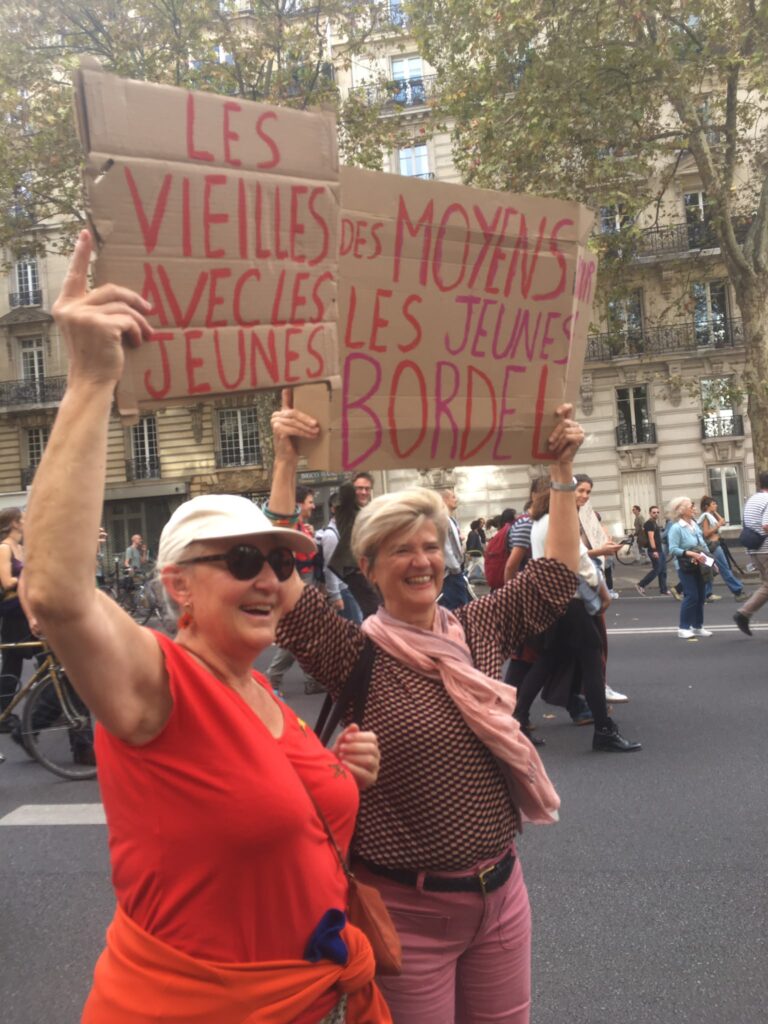
Some of the slogans, written on the many colourful, hand-painted placards carried along the picket lines and demonstrations over the past three weeks, keep coming back to me. I find myself smiling at the thought: la relève est assurée. A sense of relief, somehow.
And yet, alongside this feeling of rejuvenation, a strange shadow slowly creeps in, casting a weight over it: a sense of responsibility.
Ils tuent l’école publique car leurs enfants n’y sont pas !
La jeunesse vise le bac – la bac vise la tête
La Macro nie la démocratie
Salut ça gaze?
Que fait la police ? Ça crève les yeux !
1 prof pour 35 élèves — 5 CRS pour 1 élève
Metier formidable PROF salaire fort minable
They’re killing public schools because their kids aren’t there!
Young people aim for the baccalaureate—the bac (name of the police) aims for their head
Macro denies democracy (play on words here)
Hey, how’s it going (in french: ça gaze)?
What’s the police doing? It’s totally obvious = it put out your eyes (french expression again) !
1 teacher for every 35 students – 5 riot police for every 1 student
A wonderful profession – teaching – with a pathetic salary (with play on words again – hard to translate)
‘Austerity’ while the rich polish their image
In September 2026, the French government put forward 2027 budget cuts of €43bn, including 200 million euros cuts to the education budget. Contrast this with the super-rich who have doubled their capital since the Macron regime started; 53 individuals now own as much as 32 million French people. One of Emmanuel Macron’s first reforms was to abolish France’s tax on the super wealthy (the ISF tax) replacing it with a tax focused on real estate assets. According to an April 2025 economic report by the CGT trade union, drawing on studies from Attac, the Observatory for Tax Justice and CADTM, France lost an estimated €24 billion in tax revenue between 2018 and 2023.
Back in 2019, when Notre Dame cathedral burned, everyone was pleased to hear that the philanthropist billionaires who were able to evade tax decided to polish their image by contributing to rebuilding of the Cathedral Notre Dame. Pinot gave 100 million, Arnaud 200 million and Total Energy 100 millions. How does that square with a time of austerity?
The lycée students, as they’re known, are demanding basic rights: the right to an education that is properly funded by the State. Showing themselves to be organised, emotionally intelligent and capable of horizontal self-organisation. The striking tone is humour, and it’s a breeze of fresh air in 2026. Wit is being re enacted by Gen Z, the supposed ‘lost’ screen-bound consumer generation. Sixteen-year-olds organising debates, making placards showing wordplays and punchlines. You could read placards “On veut le bac pas la bac !” what will be for years to come punchlines mémorables as we say in French.
Some young people are being invited onto high-visibility TV programmes, among them, Seydou Ba, an incredible public speaker, eloquent keeping calm despite the journalist provocations says “ Bien plus qu’une mobilisation lycéenne, le cri de toute une génération ”. “ More than a student protest, the cry of an entire generation”.
Some of the messages went viral and thousands upon thousands of lycée students stood outside of their schools, speaking about the problems they face, organising in general assemblies, playing music and setting up kitchens from seven in the morning, every day, for a month. Their teachers and headteachers joined them, too, joining the battle for ‘aura’, that viral online trend and live street competition in which people try to outdo one another in charisma and confidence.
They not only organized in front of their schools but online, and as if it wasn’t enough, they took to the streets to march to demand their basic rights, the end to the dismantlement of public education, the destruction of public services. What the banners really speak about is a mass demand to end the current muscular form of capitalism that we live in and that has killed and still destroys every form of life on this planet. Greta Thunberg showed up to some Lycées (Sixth form colleges) in Seine Saint-Denis to send a message of international solidarity. The Lycéens were joined by most of the big unions on two consecutive Tuesdays. Hundreds of thousands of people came to support them: railway workers, barristers, nurses, doctors, university students, professors, pensioners, musicians, artists, journalists etc.. Firefighters joined some of the leading protest marches and were cheered by the youth and public sector workers. In one striking scene where you see a line of firefighters faced off against a line of CRS officers, whom retreated, the fire fighters address the CRS, calling out to them about their bonus payments and asking them to join the march instead of acting the arm of the ruling state. One can see many examples on the social media of old people joining in and hugging the students with hope and blasting happiness. These examples of intergenerational care and respect was never portrayed in mainstream news.
On the 17th, as I made my way towards Place de la République in the city centre, I was reading messages from friends. Those who had arrived early at the square, where the march was due to begin, had already been tear-gassed and surrounded by the CRS. The only thing that made me carry on, go and march through the sound of explosions and gas and grenades was a sort of instinct, a trust, that ‘surely, we will be fine because together we would be stronger’. The shared belief that we can be part of a world that should be possible. Together we must fight a democracy leaning towards fascism bit by bit.
The government sent in the police to tear-gas the protesters. In a way, that was what we expected – but not quite on that enormous scale and definitely not as early on.
From the very beginning of the day, people who arrived as early as 12:00 got circled ‘kettled up’ and gassed straight away. The Orchestre Du Nouveau Monde that has been supporting every protest was there, dozens of people among them, the musicians who were playing in the orchestra, received grenades right at their feet, on their violas, double bass etc. You can see now, on social media, the painful images of them trying to carry on playing with tearful eyes, covering their mouths and noses, until they couldn’t breathe and had to stop, protect themselves and their instruments
So, arriving at the meeting point for the start of the march we had to change our itinerary. We didn’t know where to go. The phone network was poor as we know that the authorities were using signal jammers.
We had to spread out in the streets. It felt like a chaotic start. As we arrived the atmosphere was heavy with black smoke. Huge clouds above our heads, and flames could be seen further down the streets. People walking everywhere, disorientated, were desperately trying to come back to the official march looking for where to go as most of the streets were blocked by the military police charging at random people.
In the previous weeks a joyful defiance had taken shape, groups of kids were running in front of silly armed military police. Arrayed with all their protective gear, the full equipped CRS were not able to catch them up. That day, groups of dozens of CRS were charging random groups of teenagers. Most of the young people could run fast and escape, but they were not laughing this time. The cartoon-like scenes had turned sour.
I marched with a friend from the Spanish Basque Country.She said “C, if there is another French Revolution, I want to be here.” But we had an appointment with a film maker and we had to make it on time. We managed to wiggle through the turbulence. One of the independent cinemas in the 5th arrondissement had a screening of Soulèvements. The producers and the filmmaker were to be having a discussion about the film with the audience. A 16-voice choral portrait of Les Soulèvement de La Terre, an environmental activist group based in France and founded in ’21, opposing industrial damage, land privatisation, and agricultural mega-bassines. In June 2023, the French government attempted to dissolve the group by decree, labelling their activities as ‘eco-terrorism’.
The cinema, like so many of Paris’s older picture houses, was underground. As we descended the stairs, we exchanged a strange, silent glance, both wondering what Paris would look like when we emerged again. When the film and the conversation with the film maker and his producers ended, I came back up into the street. The sun had set, and I decided to walk home. It was a long walk across Paris, taking me through Place de la Bastille. As I approached the square, I could hear grenades exploding and sense a tension in the air. In the distance, I saw the blue lights of police cars and young people running, their faces covered. Then I noticed 100 meters away from me what appeared to be undercover police officers, dressed much like the so-called ‘Black Blocs’. They were stepping out of a police car parked in a narrow side street. I felt confused, then frightened. At first, I couldn’t quite make sense of what I had just witnessed. Then I saw shop windows being smashed.
I hurried towards the nearest Métro station. By the time I reached the platform, a train was about to pull away; I jumped into the carriage just as the doors were closing. As I made my way towards a seat, I felt my throat and eyes begin to burn. The carriage was full of tear gas. What an extraordinary phenomenon, I thought: the gas had travelled all the way down here.
I let my eyes wander across the carriage, searching for someone with whom to exchange a glance, someone with whom to share my astonishment. One passenger was out of breath, beads of sweat gathering on his forehead. The tear gas seemed to be emanating from his clothes. He had probably just escaped a police chase in the streets above.
The other passengers were what one might call ordinary people who hadn’t been at the demonstration, who had perhaps spent the afternoon shopping. They sat there visibly uncomfortable, covering their noses and mouths, trying to protect themselves from the gas. No one looked at anyone else, no eye contact. Different worlds were briefly colliding in a tacit accord of bodies struggling to breathe.
After three weeks of intense mobilisation alongside these amazing, inspiring young people, working-class kids, young people from the suburbs together joined by young people from the centre, university students, workers like me and pensioners, I feel broken hearted to think that we had made them a promise that now seems almost impossible to keep: social justice. Many people now in France feel the deep shame for this reason.
It is terrifying to see the state police insulting children, dragging them along the ground and beating them mercilessly. It is terrifying to realise that young people who already bear the heaviest burden of these policies that spoil the soils, the air, the water. These same young people who speak so clearly and brilliantly about a better future, about the possibility of living a decent life, are treated as the enemy by a government whose authoritarian drift is becoming increasingly apparent.
No, I won’t speak about the smashed-up windows that symbolise capitalism (mostly luxury shops and international tax invasion companies), I will not blame those who looted shops. They are acting in a society where poverty is soaring and where so many people are pushed to the brink. Some young people took action because they felt they had no other choice; because, from an early age, they have been labelled as delinquents, as if they were already condemned to become looters. Some were no doubt mere opportunists, for whom the occasion was simply too good to miss.
A few days later on Instagram, videos turned around of the police dressed like Black Blocs and smashing up windows. A tragic parody of the villains, orchestrated by the State itself, I wondered? The Black Blocs, by contrast, tend to be more actively engaged in confronting the armed police and smashing the windows of symbolic targets: banks and multinational corporations, many of them notorious for their tax avoidance.There had been a call out for the Gilet Jaunes to join in that time. It was supposed to be their big come-back after 2019. Everyone knows that most Gilets Jaunes (Yellow Jackets, with Black Blocs back in 2019 used direct action and smashed up shop windows. What I still don’t understand today is, why, was the police not there to protect the small shops and independent business owners? They knew, as we all did, that it might happen again. Perhaps because the police had spent much of the day deploying tear gas and fuelling the anger of demonstrators, only to reappear later, playing a game of hide-and-seek in disguise, in a grotesque imitation of the Black Blocs.
On Sunday morning
I woke to find that the UK and international news headlines were dominated by images of smashed shopfronts, wrecked buildings and flames. Business owners, distraught and close to tears, were being interviewed about the devastation.
Nothing of the amazing smiles, the warm solidarity, the witty placards, the collective intelligence, the hope in our eyes, and strength, and so much courage.
Where are the images of young and old people dancing together, choirs singing, old people being acclaimed by crowds of youngsters shouting “Wesh mamie!” – “What’s up. Grandma?”
It suddenly sent me back to 2010, the student protests in the UK… just as I moved to England not knowing anyone in England, as a student wanting to learn English properly by living in the country and complete my studies. Everything that happens here happens fifteen years after it has happened in the UK.
None of the many beautiful, joyful moments are being shared in the mainstream UK media and most importantly, none are calling out the French State for its numerous failures since the appointment of Emmanuel Macron. Their first failure is to properly manage an authorised demonstration, to protect its own people, its youth, and small business owners. The second, to condemn and address the appalling misogynistic and racist insults and jokes police officers directed at young people on picket lines outside their schools.
On Monday night, Macron’s speech was painful to listen to. Announcing that those who had done the damage were going to pay a very high cost. Since this speech, the sentences meted out, lawyers report, are unprecedented. A high degree of savagery in the State response.
Like the red queen in Alice and Wonderland, Macron has winged it out of the country shouting ‘off with their heads’. One example is Mathilde, 19, who was stopped and searched on 17 October. She was found carrying a gas mask in her backpack. She appeared in court under an expedited procedure on 19 October and was given a five-month suspended prison sentence for “taking part in a group with a view to preparing acts of violence”, despite no actual act of violence being alleged against her.
A man was arrested picking up a pack of powdered milk on the pavement near a shop; he got 18 months in prison. There are hundreds of cases like this. Today in France, 10 million people live below the poverty line, and 7 million struggle to afford enough food.
Since the student movement began, some 7,950 people have been taken into police custody, 6773 aged under 18. As a comparison during the Yellow Jackets movement in 2018–2019, there were 4000 cases of police custody, including more than 1000 under 18. Young people are currently being held in degrading and inhumane conditions, in the cold, sleeping on the floor without mattresses. “They do this to traumatise them,” says a lawyer in Tribunal de Paris, Porte de Clichy where my choir went singing outside to show solidarity to the detainees getting out from police centres. This lawyer has been involved in the trials of demonstrators since 2023.
The first accounts from those who spent 48 hours in police custody are chilling. Police reportedly refused to give them water throughout the night, left the neon light on, as well as giving them false indications on what time it was. Mattresses that smelled of urine shared between five, while others slept directly on the floor amid rubbish and bottles of urine left by other detainees. Lawyers found their young clients shivering with cold. The government called on prosecutors to act swiftly and firmly. Justice moves fast when it comes to protesters and high school students, but when it comes to corrupt political leaders and high-profile rapists, victims are still waiting for justice.
A few days ago a government whistle blower revealed that the government wants to outlaw Mélanchon’s party for encouraging the riots. The only political party that has offered a real alternative that has been defending the voice of Gen Z. And now, prefectural orders are being issued one after another, banning demonstrations across cities in France. The curfew in Paris has yet to be lifted.
Kids on remand, expedited sentencing, not allowed to be in contact with their parents, out of touch with families and friends waiting outside the tribunals. The weak and vulnerable have never been so explicitly targeted. It is a modern ‘Massacre of the Innocents’. Our young people are suffering waves of austerity and poverty, being beaten, jailed with subsequent criminal records. This is our politics, at a time of environmental crisis that affects the working class first as always.
To me, and for many of us, the government should be held responsible for the widespread damage. They didn’t prevent any of the looting that seemed to happen on purpose. In an FT article it’s being said “Police were ineffective and slow to respond, allowing looting to continue into Saturday night sporadically on Sunday.” Many videos going viral on social media today confirm that.
How could the police be both out of control and blatantly provocative, as it has been for the last 6 years? Instead of doing what they are supposed to do, managing demonstrations safely and effectively, to ordinary people they seemed to be provoking and escalating tensions. The real question is and the real focus should be: why were they allowed to behave that way?
As I finished writing this, I got a text from a close friend saying: “We may have to be prepared to lose old friendships as this crisis develops, and we have to stand by our core beliefs. It can sometimes feel like a lonely road. Later.”
Constance Laisné, 18th October 2026
______________________________________________________________________________________________________
Note on the author: Constance co-founded Altgen in the UK in 2012, to support young people to set up worker cooperatives as a collaborative and democratic alternative to traditional career paths. Altgen ran an accelerator programme with five early-stage groups, and some of the participants are running successful worker co-ops ten years later.
She moved back to France in 2018 to study feminist philosophy at Paris 8 Saint-Denis University, and got involved in actors training with Theatre du Soleil. In 2020 she worked as a librarian and led a successful wildcat strike among precarious workers (‘vacataires’) at the Pompidou Centre and Public Information Library (BPI). Since then, Constance experiments with her working life, conducting a kind of workers inquiry into what it means to labour as the sole female technician in a public university. Outside her day to day job she writes and reads and has developed a theatre project with women prisoners and young people, working from Chantal Akerman’s film Jeanne Dielman, 23 quai du Commerce, 1080 Bruxelles