
This long read is a version of the text of Chapter 20 of ‘Cooperation at work: worker-owned cooperatives across the world’, published by Routledge in February 2026. A text based on of Chapter 19 of that book, a political history of worker cooperation in the UK, is shared here.
Abstract
Calverts, a worker cooperative founded in 1977, originated from a worker takeover of a printing and publishing arm of the Institute for Research in Art and Technology (IRAT). Facing initial financial hardship, the seven founders secured loans and support from the National Graphical Association (NGA) union. The cooperative’s early years were marked by modest income and a commitment to eventually paying all members the union minimum wage, which they achieved. Growth followed, accompanied by technological upgrades and relocation. The 1980s saw rapid expansion, but also internal conflict and financial losses, resolved through member solidarity. Calverts adapted to technological shifts in the printing industry, focusing on quality and niche services, which allowed them to thrive even as many competitors failed. The cooperative emphasizes worker welfare, equal pay, and democratic decision-making, fostering a strong sense of community and resilience. Calverts’ success demonstrates the viability and adaptability of worker cooperatives, even within a challenging market, highlighting the benefits of collective ownership and democratic governance.
| Sector of activity | Printing and graphic design |
| Number of workers | 13 |
| Number of worker-members | 13 |
| Turnover (USD) | USD 1.86 million |
| Website | https://www.calverts.coop |
Basic data
Formation
Calverts was founded in 1977, after an industrial dispute and worker takeover of the printing and publishing arm of the Institute for Research in Art and Technology (IRAT), also known as New Arts Lab.
In spring 1975, IRAT took over the firm J Bellers, a radical press run by Janos Abel, a Hungarian emigre and veteran of the 1956 uprising. IRAT then recruited a small cohort of young workers, including trainees, who joined on the understanding that the combined operation would become a cooperative. Conflict arose between the worker group and the owner-managers as conversion discussions dragged on through the hot summer of 1976. Some of the new recruits were threatened with dismissal in August, leading to a strike.
In September, the worker group of seven met at the North Star pub and decided to form an independent cooperative. Over the following six months they raised USD 2,800 in loan capital from their own savings to buy some of IRAT’s equipment, and took over the lease on its premises, while securing commitments from many of IRAT’s customers and commercial credit from suppliers. A key success was persuading the printing industry’s main craft union, the National Graphical Association (NGA), to admit the workers into membership and lend moral support.
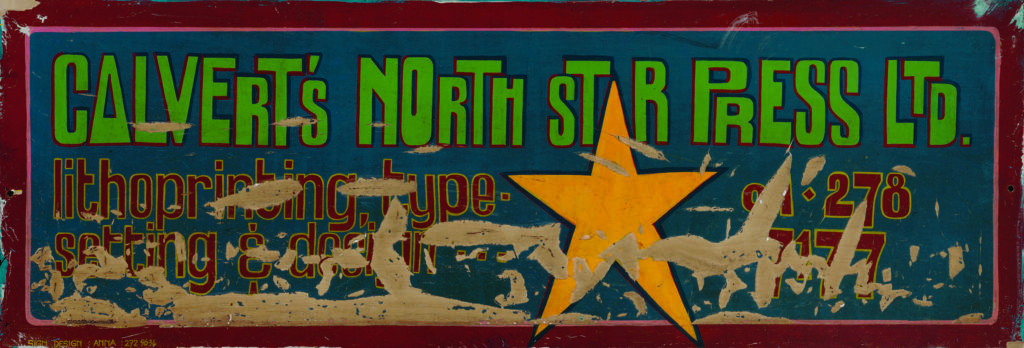
The founders called the new cooperative Calvert’s North Star Press, combining the names of the bar where the cooperative’s founding meetings took place and the title of a prominent Chartist newspaper, while honouring Elizabeth and Giles Calvert, radical printers of the English revolutionary period, whose premises ‘at the sign of the Black Eagle’ were close to the cooperative’s first workshop in Clerkenwell, central London.
Calverts registered legally as a cooperative in May 1977, becoming one of the first worker cooperatives to adopt ICOM’s new model rules after the passing of the 1976 Industrial Common Ownership Act. The cooperative started trading as Calverts in September 1977. The ‘objects’ provision of its legal document read simply: “Calverts’s North Star Press shall be a printing cooperative operating under workers’ control”. The founder members were John Berry, Lorraine Holdstock, Nicola Palmer, Clare Palmer, Carolyn Nevett, Tony Waterhouse and Marilyn Noad. Janos Abel from J Bellers went on to found another printing cooperative, Spiderweb, in 1979.
In the transitional months of trading, the cooperative had almost no working capital. Tony Waterhouse remembers: “I managed to buy a skip load of waste hardboard for USD 2 plus a stack of studding timber. I pulled out and straightened hundreds of nails, then with tape, claw hammer and panel saw, I furnished the workshop with ‘favela’ furniture – I was brought up in Sao Paolo.”
For the first few months, only the two members with children received wages, while workers without wages subsisted on state unemployment and social benefits. However the members made a pact: all of them would receive wages after six months, or the cooperative would close. After twelve months, all of the workers would be paid at least the NGA union minimum rate, on the same condition. Sales turnover in the first full year was just USD 50,000 but those deadlines were met.
Context
In 2009 a former member of Calverts, Jessica Baines, published a wiki website surveying the radical and community printshops in the UK from 1968-1998, called The freedom of the press belongs to those who control the presses. She identified more than 40 enterprises, further categorising them as poster design collectives, service printers, typesetters and print resource centres. Most of them were in London.
In the pre-internet era, these presses and collectives served networks of social, cultural and political activists and organisations by designing and producing the books, pamphlets, posters, newspapers and leaflets which they needed to disseminate propaganda, share information, organise public actions and promote their causes. In London, Calverts was one of six worker cooperative service printers, meaning that it operated on a fully commercial basis.
The outputs of the printing presses and design collectives were often disseminated through ‘movement’ distribution houses and radical bookshops. Almost all of these enterprises operated on democratic and egalitarian lines, although only a minority explicitly adopted the worker cooperative form. More broadly, the worker cooperative milieu in the UK’s capital was big enough to support a regional network called London ICOM, and a small worker cooperative education unit called London Cooperative Training, both of which continued until 1997. The printing and graphic design cooperatives often collaborated and supported each other, despite being in formal competition. In 1986 they formed a short-lived network called London Cooperative Printers Association, working together in areas of mutual interest such as purchasing, sharing commercial intelligence and organising worker exchanges.
The 1980s was a period of general growth in commercial printing, publishing and papermaking, and until the internet boom it remained the UK’s seventh largest industry by number of people employed. An ever-growing market and high prices meant there was plenty of commercial space for the low-tech service cooperatives, but their worker recruits were usually trainees, self-taught people or university graduates without trade skills.
Before 1986 apprenticeships, job entry and continuing employment in the newspaper and general printing sectors were heavily regulated by craft and trade unions at every level. Obtaining a ‘union card’ therefore became a working life goal for individual cooperative members, while union recognition of the cooperative enterprises themselves was a commercial necessity. Over time, unions also became a natural and significant part of the service cooperatives’ customer base. Calverts was an NGA ‘closed shop’ from the start, meaning that all workers were required to join the union. It remained an informal closed shop long after such arrangements were made illegal in 1990. The print unions’ power was gradually suppressed and eventually broken by aggressive employer action in the newspaper industry, combined with a series of anti-union laws passed by Conservative governments between 1980 and 1993.
Early progress
To begin with, Calverts operated with the very basic printing equipment it was able to buy from IRAT, including two small format duplicating machines, a golfball typewriter for setting up columns of type and a chemical transfer plate maker. In 1978, loans from members and a USD 650 loan from ICOF enabled the cooperative to buy a paper guillotine and A3 format litho printing press. In 1982 the cooperative bought its first A3 format premium quality press, and a photographic print-down frame for making metal printing plates.
In the first five years, turnover grew by an average of 35% year-on-year. The cooperative expanded to eight members, and in 1983 it borrowed USD 22,000 in asset finance from a private bank to buy its first ‘commercial industry standard’ A2 format press, and a phototypesetting machine. Careful financial management meant that the cooperative was able to slowly raise real wages, although on paper its liquid assets, balance sheet and solvency all stayed negative until 1984.
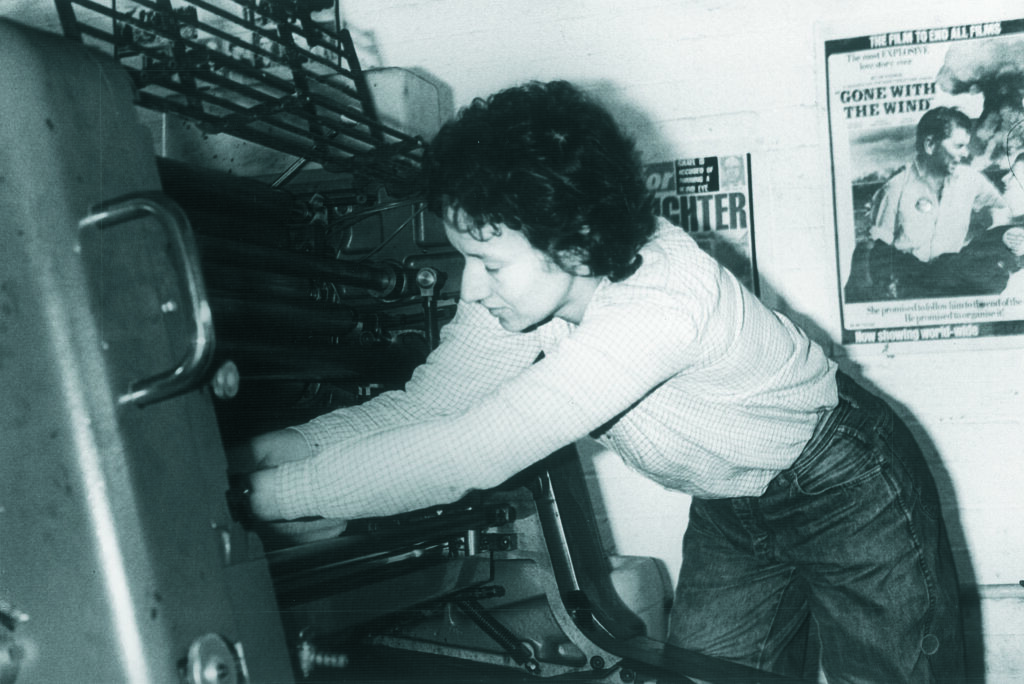
Nicola Palmer on the Heidelberg SORK A2 litho press, c1984
Although Calverts worker cohort changed quickly in the early years – by 1985, none of the founders remained – the cooperative established a number of key policies and approaches which were to underpin its cohesion and growth over the first decade.
Firstly, it established a standard working week of 35 hours and equal hourly pay across all job functions, which it maintains to this day. Calverts cleaner receives the same hourly rate as the finance director.
Second, it applied a policy of ‘one worker, one job’ such that members were not allowed to take additional employment outside the cooperative, without a special agreement.
Third, all overtime was paid at a premium rate or worked as ‘time in lieu’, and carefully monitored with a view to increasing the number of full time positions, rather than increasing the amount of paid hours per worker.
Fourth, it applied strong financial controls, with collective decision making, detailed management accounts discussed each month, and full transparency on other management and commercial matters.
Fifth, it resolved to charge all customers its full commercial cost recovery rates plus a profit margin, with an element of flexibility – while permitting and encouraging members to use the production resources of the cooperative in their free time, to produce design and print outputs for the bare cost of the materials. A condition of this ‘home industry’ was that the product should be ‘not for profit’, and each project consented to by the members’ meeting.
Sixth, although workers were recruited for specific roles, the cooperative encouraged skill sharing and flexibility across job functions. This meant that worker-members were able to develop new aptitudes and capacities, and the cooperative could produce efficiently.
Seventh, it determined to raise regular wages whenever possible, rather than distributing a part of surpluses in member bonuses, and committed to improving long-term productivity by reinvesting in technology instead of taking short-term gains as returns.
All these policies and practices are in place nearly 50 years later, with the exception of the ‘one worker one job’ rule as more workers are now part time, and the cost of living in one of the world’s most expensive cities has increased exponentially.
As Calverts gradually evolved from a low-cost, low-tech print shop to a professional provider of creative and production services, the level of skills required in each job position meant it increasingly needed to recruit skilled workers in design, reprographics, printing technology, marketing or commercial administration. Yet today, most of Calverts members can work across more than one traditional job function, or take on a cooperative governance role. Over the years, many members have taken advantage of Calverts positive approach to internal cross-training or subsidised external learning, to develop new skills and work in different areas of the business.
Crisis, recovery and innovation
In 1985, Calverts outgrew its Clerkenwell workshop, and the cooperative signed a 10 year lease on a 600m2 factory and studio space over two floors of a former garment factory in the Shoreditch district, 5km to the east. At that time, Shoreditch was an unfashionable working class neighbourhood, home to a young Bangladeshi migrant population that was gradually replacing the traditional Jewish community.
The move exhausted the cooperative’s cash reserve, but trading continued to expand quickly. In 1986 the cooperative bought a two-colour 52cm x 72cm format printing press, again financed by a private bank loan secured on the asset. Between 1984 and 1989, year-on-year turnover increased by an average of 26% reaching USD 820,000. The number of worker-members reached 20. But the pace of growth was creating serious stresses.
By 1988, the office team coordinating production, finance and sales were mainly newer recruits from outside the printing industry, while the ‘factory floor’ team group now included a number of older workers with more traditional attitudes to skills demarcation and the role of managers. Efficiency and profitability declined. Despite high turnover growth, the cooperative incurred heavy trading losses in 1987-88. The tension resulted in conflict and disagreements among the members, and in 1989 the whole ‘front of house’ group – with the exception of its newest young recruit – resigned at the same time.
The remaining workers immediately reorganised to cover coordination, administration and sales functions, and a founder member returned in a financial firefighting role. The firm was technically insolvent, and Nicola Palmer remembers spending much of 1990 persuading creditors to wait longer for their money, rather than trigger a forced shutdown. The cooperative’s original spirit of solidarity revived, and trading losses stopped – but business continued to be difficult, with an economic recession in 1992 bringing a further loss of trading volume and pressure on prices.
By 1994, the cooperative was able to make new investments in imaging technology and an advanced management information system. Productivity improved, and the business returned to growth, with membership stabilising at around 14 workers. It is worth noting that there were no forced worker redundancies at any point in the crisis and rebuilding period – or indeed, at any time in Calverts history.
In 1998 Calverts bought its first four-colour printing press, a 20 year old second-hand machine. At this point, most of Calverts production was still relatively simple black-and-white or ‘spot’ colour work such as newsletters, magazines, reports, stationery and leaflets. The clients were mainly associations, campaigns, small businesses, universities and charities. The printing presses were already well-used when Calverts bought them, but there was now a culture of workers pushing their skills and the equipment to their limits, to be able to produce better and more challenging work for clients in the arts, creative and marketing sectors. The members decided on a ‘quality strategy’, investing first in the newest and best design, reprographic and platemaking technology, and then in a brand new, state-of-the-art, five-colour press.
Leaving the twentieth century
By 2000, Shoreditch was becoming a gentrified district, and rents were rising quickly. The cooperative made another expensive move, again a few kilometres further east. At the same time, it took out an USD 0.8 million loan to buy the new multicolour litho printing machine. The decisive ‘move to quality’ was underway – exactly in a period when London’s general printing trade was declining.
By the first decade of the new century, digital applications were quickly eroding demand for books, magazines, newsletters, business stationery, directories and advertising-based print. Calverts responded by competing on quality and bespoke service, rather than chasing business on price alone, and by electing not to diversify into purely digital services – although the studio team innovated in branding and graphic design for web applications. As a result, the cooperative was able to build a strong reputation in the demanding market for arts publishing and premium print, and thus able to maintain good jobs, innovate and endure while hundreds of other UK small printing companies disappeared, with much of the reduced total volume of demand now being met by suppliers in lower cost European and Far Eastern countries.
Calverts reached its highest headline turnover in 2008, at USD 1.85 million. With the exception of the years after the 2009 economic crisis and the 2020 Covid emergency, it has tended towards an equilibrium of business volume and employment since that time, while focusing on raising the level of gross surplus by specialising in higher added value print consulting, creative and reprographic services. After 2010, it also began to establish a new and profitable line in digital printing – enabling the cooperative to provide affordable premium print in small editions – and added wide format inkjet and Risograph printing to its traditional lithographic offer.
During the 1990s, when cooperatives were widely seen in the UK as old-fashioned and inefficient, Calverts did not prominently advertise its cooperative identity as a ‘unique selling point’. However after the formation of Cooperatives UK in 2001, it began to reach out to the wider cooperative movement as a potential source of new business, and a focus on cooperative identity and intertrading became key elements of the cooperative’s marketing effort. Cooperatives UK itself became a client, and by 2014 other cooperatives – large and small, in the UK and abroad – made up one of Calverts’ most important client segments. At different times, Calverts members also served on the Worker Cooperative Council, the trustee committee of ICOF, and the boards of Cooperatives UK, CECOP and CICOPA.
In 2012, Calverts won a worldwide tender from the International Cooperative Alliance to research, design and produce a new global cooperative symbol, and to create a fresh visual brand architecture for the ICA itself. It designed a 22-question survey in three languages, inviting cooperators to articulate their interpretation of cooperative identity, and share symbols of cooperation from their own cultures. Detailed survey responses were received from more than 1,000 participants in 93 countries, and the resulting synthesis and design – known as the global coop marque – was launched at the ICA’s 2013 congress in Cape Town. The marque was freely and successfully adopted by small and large primary cooperatives, federations and cooperative support organisations around the world, and it remains a powerful unifying symbol of the movement.
Democratic innovation and worker welfare
It is sometimes said that in cooperatives, most business failures can be blamed on failures of cooperative governance. According to CICOPA’s World Declaration on Worker Cooperatives, worker cooperatives should “practice democracy in the decisive instances of the organisation and in all the stages of the management process”. In common with a number of other UK worker cooperatives, Calverts has radically interpreted this principle by suppressing executive management as a status or special role, while devolving day-to-day decision making responsibility to team groups and individual members. Information sharing and one-to-one conversations are seen as integral to the cooperative’s governance culture, to the extent that the cooperative planned its common spaces to maximise the opportunities for ‘water cooler’ interactions between staff. Only general level matters are reserved for collective meetings, where the majority of decisions are made using a consensus or consent-based process. Voting is sometimes used where it is required by legal statute, or to resolve non-critical but time sensitive matters.
This approach, which recognises governance as a ‘complex responsive process’, allows the greatest intelligence of the members – individually and collectively – to bear on heavy and complex questions, and mitigates the risk of value-destroying ‘strategic’ decision making by poorly-informed executives, whose base function in most firms is to enforce vertical organisational discipline. Perhaps counter-intuitively, it also minimises the amount of time members spend in unproductive meetings. Unquestionably, it produces better and more timely business decisions.
At the ‘shop floor’ level, the need for good communication and efficiency makes each working day an exercise in collective enquiry. Are we wasting time or energy? How is our work allocated and coordinated? Are we using appropriate technologies? Do we have the right feedback processes? Do we have truly equitable working relationships? This produces an intolerance of divisions between workers based on characteristics such as gender, ethnicity, belief, sociological class background or educational attainment, which undermine solidarity and often appear in hierarchical organisations as a tool to ‘divide and rule’. The push towards equality also helps to break down the separation between ‘blue collar’ and ‘white collar’ workers, ‘manual’ and ‘intellectual’ work, and so on. We might say that equality, diversity and inclusion (EDI) is more a product of Calverts’ cooperative habitus, than the product of a human resources policy.
An efficient cooperative working culture liberates the value in time and money that makes decent jobs possible. Calverts standard working week is two hours less than the average for full time workers in the UK, and paid holidays one week more. Hourly pay is around the median average for all Londoners, but 25% higher than the average UK rate for experienced print workers. Other worker rights include paid emergency and bereavement leave, variable working arrangements, unpaid sabbatical leave and insurance-based income protection in the case of a serious accident or long-term sickness – none of which are generally offered in the industry.
A secondary effect of these policies are a low rate of staff turnover with high skills retention. The current average employment duration is 16 years. This in turn underpins business durability and a relatively high rate of return on capital employed.
The question of capital
Lack of access to capital is a historic barrier to the growth of worker cooperatives in the UK, as elsewhere, although as the Calverts example shows this has not prevented groups of determined workers from starting or assuming control of enterprises – even in industries where some cash to purchase fixed assets is needed, to supplement the ‘sweat equity’ of the members.
Calverts has historically chosen to raise investment money through debt, rather than through equity or by seeking non-repayable grants. It could be said that the members had no choice, since the UK had no cooperative investment institutions, and the members themselves had small savings. After all, capitalism is a social relationship, in which being a ‘person without capital’ is almost the definition of a worker. So in the early years, once the members had grasped the capitalist freedom of limited personal liability, debt was seen as perfectly acceptable, even at a high rate of interest. Why would we use our own money, if we can borrow from a bank? If we can make the repayments, we’ll be OK. If we can’t make the repayments, we just walk away.
Later generations of UK worker cooperators are noticeably more cautious about debt, perhaps because so many young people are saddled with the obligation to repay large personal student loans. Until 1990, university education in the UK was free, and in the 1970s most students also qualified for maintenance grants from the state.
When Calverts borrowed money from private banks to buy printing presses, it was always under an asset finance agreement, where the equipment itself was the security on the loan – rather like a house purchase mortgage. When Calverts borrowed from ICOF, the lender obtained its security by taking a ‘floating charge’ on the cooperative’s assets. In general, the members did not provide personal guarantees, but when this was unavoidable – for instance, when a landlord required personal guarantors for a long lease – two members with the smallest personal assets volunteered to be the guarantors, and the other members signed a legal agreement to indemnify the two if everything went wrong.
Under its original ‘common ownership’ statute, Calverts members’ financial participation was limited to £1 each, and only workers could be members. In 2023, this was changed to allow members to take additional non-voting shares, and also to create a new category of external investor members, with strict limits on share interest and voting rights. In the future, this might be an avenue for raising investment cash from key customers or supporters, but it would be a big change.
| “At our bi-weekly meetings everyone is welcome to speak – and can speak. There is healthy debate when we need to make decisions, and I feel everyone has equal voice. In other places, I’ve witnessed a culture of deference to managers. In Calverts, you have to persuade your colleagues with sound reasoning, to advance an argument in favour of a particular course of action, which is a good skill. I haven’t been here as long as most other members but I feel I can trust their collective judgement and experience. In other companies where I’ve worked, there has been a lot of ‘smoke and mirrors’ – you have no idea how well or badly the company is doing, until one day a manager comes in and informs you that there will be 50% redundancies. At Calverts, you can all see the waves coming from a long way off, which gives you time and space to respond”. Katie Sheppard (worker since February 2023, member since December 2023). |
Impacts
Beyond providing secure, high quality jobs, to evaluate Calverts impacts locally and generally it is necessary to return to its objectives as a business, and see how these have played out for its intersecting communities of place and interest.
Creative services and the printing industry are both vertically segmented and horizontally networked. Design and print firms often operate in complex supply chains, with powerful clients and their agencies at the top, and sometimes characterised by corrupt and exploitative business practices. Calverts aims to influence the field by extending the principle of equity to its business relationships, cultivating transparent and ethical partnerships with both customers and suppliers.
The cooperative is dependent on a network of smaller, mainly local firms providing specialist print and business services as well as freelance workers and larger suppliers. It nurtures its base of suppliers and subcontractors as carefully as it looks after its clients, and some of its trading relationships go back to its beginnings. It has never defaulted on a contract, and in evidence of the trust built up over time, is one of a very small number of firms in a volatile industry to have an extended commercial line of credit with major suppliers.
The ethical roots of the cooperative’s approach to environmental responsibility lie in an original concern to protect the health and wellbeing of its own workers, and the demands of the social and ecology movements Calverts serves, including organisations such as the Green Party and Friends of the Earth as well as many grass roots and local environmental campaigns.
In the 1980s, Calverts collaborated with the worker cooperative Paperback to develop and test some of the first 100% recycled graphical printing papers, and lobbied suppliers to accelerate the development of vegetable oil based inks and non-toxic cleaning chemicals that are now in standard use. More recently, it helped design and promote circular economy initiatives in collaboration with organisations such as the Royal Society of Arts and Manufacturing. Calverts is now a UK industry leader in environmentally responsible print. It maintains Forest Stewardship Council (FSC®) certification, and works under a rigorous environmental management system with ISO14001 accreditation.
In the field of employment practice, Calverts advertised employment opportunities in the womens’, gay and ethnic minority press, recruiting and training people who would have normally been excluded from the industry or restricted to lower-paid jobs, and bringing female and migrant workers into machine printing and reprographic technician roles. In the 1980s, Calverts trained perhaps half of all the UK’s female large format printing press operators.
Calverts members, like most workers in London, live, work and play across different neighbourhoods of the city and its suburbs, and is not easy to measure the local impacts of a small business operating in a large metropolitan region and capitalist centre like London – or even in its local municipality Tower Hamlets, which has a population of 320,000. Scored on indices of social deprivation such as overcrowding and ill health, Tower Hamlets is one of the UK’s poorest boroughs; but by average in-work income it is one of its richest, because the statistic is skewed by very high salaries in the financial district of Canary Wharf.
The cooperative contributes to equitable economic development by supporting organisations such as the East End Trades Guild, a cooperative of artisans and small traders, and by participating in local cooperative development networks. It also provides some free or low-cost services to local non-profit projects, cultural groups and campaigns, including a womens’ literacy project, a food cooperative and an infants’ school. Another contribution is raising awareness of the cooperative model among arts and creative industries students, who graduate into a precarious and exploitative jobs market from London’s universities at the rate of 50,000 every year. Calverts members have mentored or advised a number of creative and digital technology worker cooperative startups.
Conclusion
It has been axiomatic for Calverts that it should invest in its people and technology, rather than diverting resources into non-core activities – such as, for instance, owning its own building. But the real cost of rented commercial space in inner London has risen steeply since 1985, driving traditional manufacturing firms out of the city or out of business altogether.
In 2021, Calverts nearly became homeless because its landlord, attracted by the prospect of letting his property on a premium rent to a ‘just in time’ food delivery company, refused to renew the cooperative’s lease at short notice. Even if the cooperative could afford a forced relocation for the fourth time, London’s main electrical infrastructure provider would not be able to install a power supply, sufficient for the large presses, for at least 12 months. A new lease was eventually negotiated, with a 70% rent increase to USD 140,000 per year. Although Calverts has no extractive owners, it has handed large amounts of money over the years to rentiers and private investment bankers, as well as needing to finance periodic relocation costs.
No small business is immune to seismic changes in the economic landscape. It is not possible to fully plan for the social and political shocks that might affect Calverts future. A strong local and global network of worker-directed enterprises, responsive to the communities in which they trade and operate, is essential to growing the cooperative economy and securing a better future for workers everywhere. Beyond this, how does a single worker cooperative build resilience?
Calverts’ experience demonstrates that organic growth, collective purpose and responding dynamically to changes in the composition of the economy and to political challenges, is more likely to deliver for present and future members than any top-down grand strategy. If the cooperative keeps sight of its principles and purpose, and ‘all other things being equal’, Calverts can be confident in its capacity to keep evolving, to keep serving the needs and aspirations of its members, whoever they are, for years to come.
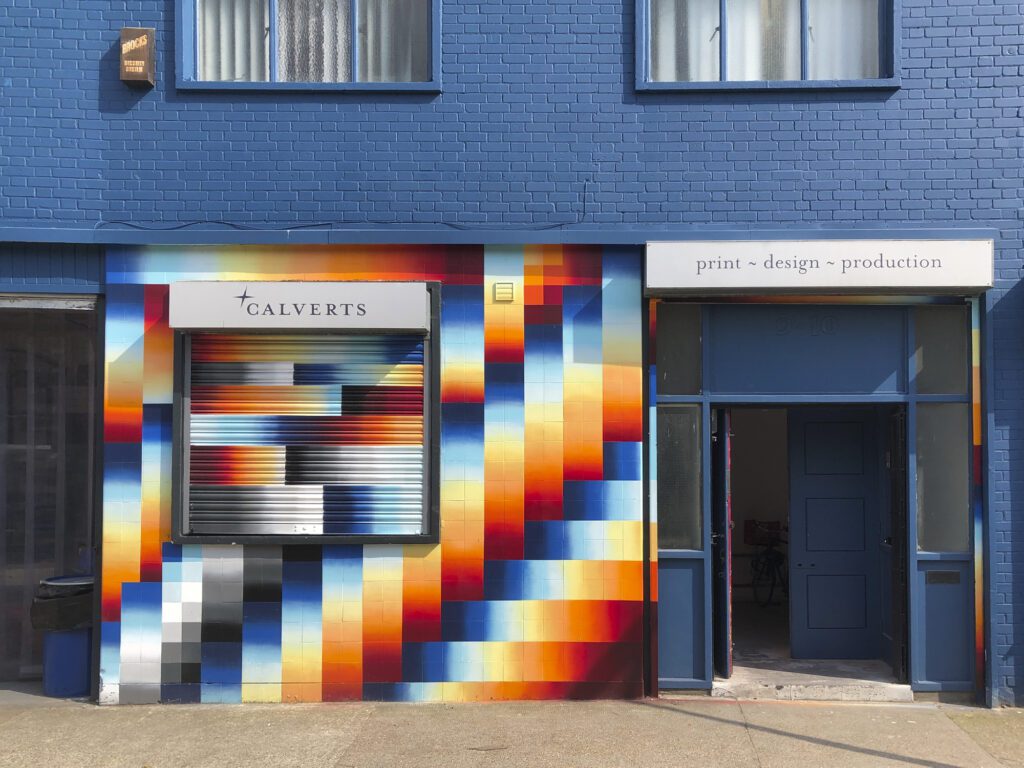
Calverts premises at The Oval, Bethnal Green, London in 2024
Further reading
Fenwick Weavers’ Society
The Combination Acts, 1799 and 1800 https://en.wikipedia.org/wiki/Combination_Act_1799#:~:text=Collectively%20these%20acts%20were%20known,common%20law%20as%20a%20misdemeanor.
How Blair Killed the Cooperatives – Huckfield, Lesley. Manchester University Press, 2021
Workers’ Cooperatives: Jobs and Dreams – Thornley, Jenny. Heinemann Educational Publishers, 1981.